Showing posts with label lp. Show all posts

5.13.2012

Latinity Points (XP) as a Replacement for Grades, Part 4

In the previous three parts of this exercise, I laid out the criteria required in order to evaluate without grading, explained how Latinity Points are utilized as a part of Operation LAPIS, and then provided a full discussion and response from a group of three students. In this final part my aim is to elaborate on what the end of that process looks like, specifically when it comes time to assign a traditional grade in a very non-traditional classroom. As a reminder from the first post, the following were the four criteria that I argued had to be a part of this system.

  1. Continuous embedded formative assessment of progress
  2. A record system with meaningful feedback towards meeting learning objectives
  3. A record of all student work
  4. Student agency in the evaluation process

1) Continuous embedded formative assessment: Every component of Operation LAPIS is designed with this at the core. There are no superfluous mechanics or deliberately gamified elements for cheap extrinsic motivation. Every episode requires the students-as-operatives not only to read and comprehend Latin but also to apply relevant cultural and historical information through both guided and independent research. Every episode also requires them to collaborate with their teammates to roleplay their character’s actions through a particular world-view. As built in differentiation, students can be challenged to build their responses in original Latin composition as well -- which many of them attempt at least in some small part. Simply put, every element requires them to actively draw on skills they’ve gained while applying new skills and knowledge.

2) A record system with meaningful feedback: All of their LPs are awarded through a shared (between myself and the student) document known as the Operative Dossier. Once we start to get into a grove at the start of the year, the students understand that an LP award in the 260s or higher is on the right track, while something around 200s means that more work is needed. Included in each dossier is a ‘Transmission from Mission Control’ which can provide direct feedback in a way that doesn’t break from the immersion of the ‘students-as-operatives’. Since all operatives have access to the rubric, specific attention can be drawn to parts of their contributions that did not meet expectations.


3) A record of all student work: This is the easy part, thanks to Google Docs and Edmodo as the platform of choice for collaboration and discussion. All student work in Google Docs is shared between myself and the student. At any point, through the commenting feature in Google Docs, I’m able to provide specific and detailed feedback. Since LPs are deliberately not a masked grading system, operatives can choose to respond to the feedback, fix errors, and gain more LPs for revising their work.

All team discussion happens in secure sub-groups on the Edmodo platform. If there is every a question from a parent (or from a student), it takes almost no time to call up a record of the student’s contributions to reflect on how they are (or aren’t) meeting the criteria spelled out on the rubric. This record of work is also important as teams will often recall information from the past immersions as being useful for the current -- scrolling down their team discussions quickly gives them access to that material in a way that a test or quiz shoved into a binder, or the nebulous black hole known as a backpack, simply cannot.

Now for the fun part.

4) Student agency in the evaluation process: When it comes time to report grades at the prescribed four times per year, I ask all of my students to first submit a self-reflection piece. I ask them to evaluate their strengths, their weaknesses, mention one or two episodes that they felt they did a fantastic job contributing to, and also to mention one or two episodes where they think they could have provided more to the team discussion. In addition, we take a look at the current LP totals and I give them an intentionally wide range of values for letter grades (intentional overlap, as well). Ideally, I’d sit down with each student individually and have a face-to-face discussion, but with 25+ students in each classroom, logistically it would be too difficult to accomplish as a part of a standard high school schedule. Instead I require the students to email me their response, which, in of itself, hits on some of the secondary learning objectives of written communication, etc. At the end of their self-reflection, they assign themselves a grade which they think they are deserving of. The wonderful thing about this endeavor is that almost always they hold themselves to tougher standards than I and, in my reply, I get to “talk them up” a bit.

Do I get the occasional student that says, “Sweet? I get to assign myself a grade? I get an A!”? Absolutely. However, with the continuous embedded formative assessment, feedback through carefully constructed mechanic, and an accessible record system, it then because a teachable moment when they are asked to demonstrate in what ways they met the learning objectives to warrant that ‘A’.

4.24.2012

Latinity Points (XP) as a Replacement for Grades, Part 3

Continuing from Part 2, here is a complete transcript from one of the teams engaged in a recent mission. 

The quick synopsis: the Recentiī were thrust back into a historical training mission. This time, they were on the deck of Duilius' flagship just prior to the important Battle of Mylae during the First Punic War. Remember, Rome had just lost a number (read: every) major naval battle since the outbreak of war, including most recently at the Lipari Islands where Scipio Asina was captured by the Carthaginian fleet. 

Duilius, feeling a bit uneasy (and rightfully so), required a little pep talk despite the tactical advantage he was about the unveil -- the corvus. At the moment the Recentiī encounter him, Duilius is questioning the advice given to him by the Corneliī and the Claudiī about the nature of the patrician class, the plebeians, and how to manipulate power in Rome. My commentary will follow the full transcript:


Student 1- so i was thinking that we need to find another was to glorify Rome without tricking the plebs...wait -_- thats what the paragraph says..

Student 1 - hmmm it turns out that the same fate that happened to Appius Caudex and Scipio Asinus happened to Duilius...he was given control during the war, but after that he "never held another office of high command" i wonder why? i mean he seems like a nice enough guy...not one to be a "donkey".

Student 2 - Maybe in these men's cases, the plebs caught on to what the two patricians had done and scorned them for the rest of their political careers choosing instead to support other figures?

Student 2 - Oooh, I bet Student 3 and I can relate this to some recent thing we learned in History class. Machiavelli, a Renaissance writer, produced The Prince which highlighted what he thought were the necessary qualities to a successful leader. It included things as being deceptive, any immoral means as long as it accomplishes the desired end results. That's what Cornelii and Claudii had advocated and currently, Asinus is trying to convince Dulius to do.

Student 2 - So correlating to our need to suggest some guidelines which Dulius should follow in order to achieve victory and fame, we can give him tips which he should not do.
Such as:
1.) Being impatient ( Eager to secure such an important port and to cover himself with glory, Scipio rushed to the Lipari islands without considering security.)

2.) Rallying up his men, which luckily enough, Dulius is planned on doing though he has no idea how... (The crews panicked and escaped to land, leaving the ships unattended and Scipio Asina to be made prisoner by the Carthaginians).

Student 2 - Oh, I didn't know who you were referring to when you said he never held another office of high command. Disregard my post below yours. Or.. I can just delete it. :D  
Student 3 - Exactly Student 2! That's what I was thinking. They thought it was better to be feared than loved. Maybe we should just tell Dulius to do what he knows is considered to be "lofty". (5 points for english vocab :D)  
Student 2 - @Student 1 That is a good point though, it's ironic. "Neither the humiliation, nor that Scipio Asina was the first Roman admiral to lose a battle, ended his career; in 254 BC, Scipio Asina was elected consul for the second time"  
Student 3 - It's almost as if the defeat ruined his career......sounds like they don't like failure....

Student 2 - Maybe to preserve the kind of honor and respect he received (which does come by every day), Dulius secured his position by eliminating any possibility of him being humiliated by loss or failure.

Student 2 - Or as part of his plan to be "good cop" and not "bad cop" like Asinus wanted, he just played modest.

Student 3 - We could also tell him not to expect too much but just treat it as a normal battle. Stress often brings effort and quality down....  
Student 2 - What gens is Dulius? Will that offer us to some insight as to what he was brought up to support?

Student 1 - I need to correct my last statement...i wasnt talking about Scipio Asinus or Appius Caudex...I mean that Duilius suffered the same fate as them  
Student 2 - "Not much is known about his family background or early career, since he was a novus homo, meaning not belonging to a traditional family of Roman aristocrats".

Student 1 - so at least he raised his own rank..he relates to the plebs

Student 3 - Ok, so basically we're just telling him good luck lol.  
Student 2 - That means Dulius is not naturally inclined to exploit the plebs or Roman population as easily as the patricians would've. Why should we mold him in their face? We should let him be, it seems as though that's what he had done in historical context, be honest with his fleet.  
Student 2 - After all, he did win the title of Censor. "The censor was an officer in ancient Rome who was responsible for maintaining the census, supervising public morality, and overseeing certain aspects of the government's finances."  
Student 2 - Emphasis on PUBLIC MORALITY.

Student 3 -Oh wow then good. Looks like we got a plan :D  
Student 2 - So are we agreed on this, Dulius should abandon and trash all of the notions, talking of Patricians and influencing the population selfishly, delivered to him by Asinus?


So what was the end result? After their discussion on Edmodo, the crew headed over to Google Docs and collaboratively hashed out their response for the evening. Looking back on the revision history, it is easy to see that it was a fairly balanced effort by all three members, especially the Latin composition passage. I present it, unedited, below:

Horatiana pats the back of a troubled friend in need, linked by mutual suffering. She too knew only too well the stress and pressure of being expected to live up to something practically unattainable. Left unattended, this problem can be crushing when the expectation is not met or properly challenged; casting a lifelong burden. Especially when one more loss could spell out the untimely end of the Roman civilization, the pressure is unbearable upon the shoulders of one man. She wished with her heart and soul to dispel the fear radiating from this man.
 
Horatiana ad vultum Duilii spectat. ille sudabat et tremebat valde! illa debet cogitare celeriter aut omnis spes est perdita. scivit Appium Caudem et Scipium Asinum luserant populum. Et illi facerunt id solummodo sibi. Duilius non debet agere illud si vult populum amare eum. Est optimum acquiere fides classum. Bonus imperator, sicut tu, non requirat potentiam Lapidis. Scipio habuit lapidem et ille erat captivus. Classes faciunt imperatorum potentiam.

Horatiana, in the last fleeting minutes before approaching the islands, drills Dulius in the makings of a fine leader. The patience, the strategy, bravery, modesty, listening skills, the willingness to sacrifice oneself for the bigger picture, and most of all, to act as an extension of the navy itself, amplifying its strengths many times. Speak from your heart in all honesty to your men. You do not need deception to get them to fall in line. Fear only works to an extent. No, what you need is compassion. If you speak with true decency, then why will there be any doubt the men will not show the same love you have for Rome? You need not to worry about your men, but instead how you can guide them with virtue because only then will they live up to your standards. Or slave away as one of the patricians' mindless puppets. That's what the Claudii and Cornelii probably had in store for you. But deep down, you had always doubted their methods. You're a novus homo, for goodness' sake.

Already I'm crossing over to TL:DR territory so I'll keep my commentary short. We have a standard response rubric located at this link. I'll focus on Student 2 for assessing how well they did meeting the learning objectives.

Remember, this was a single night's worth of work and they received no grade on it in the traditional sense. Student 2 receive 292 LPs for their work on this immersion prompt. Contributions such as Student 2's are the easiest the award points for -- I think most readers will agree this student exceeded standards for a Latin I class for Expression of Ideas, Elaboration, Cultural Competence, Risk Taking, and also the two Latin composition categories, Grammar and Vocabulary. I especially liked this student's ability to connect to what they were learning in their history class about Machiavelli and his views on how a leader should operate. Student 2 was respectful and helpful towards the other team members and it is clear that all members benefited greatly from the social and collaborative setting.

The collaborative setting also allows an opportunity for different members to showcase their talents in different ways -- Student 2, for example, excels at research and pulling out relevant information and distilling that for the team. Another student has a knack for elaborating the role-playing for their Recentia, Horatiana, and the third does very well with fine tuning the grammar in their compositions.

Again, I want to stress that all of this work (and it is substantial) is done with almost no expectation of extrinsic rewards. These students (and many of their classmates) are taking part in exploring these missions at great lengths purely for the learning that comes out of doing so. In the final installment, I'll spend some time reflecting about how I leverage Latinity Points as a launching point for a discussion about evaluation -- not the basis for evaluation -- when it comes time to report formal grades for marking periods.

4.02.2012

Latinity Points (XP) as a Replacement for Grades, part 2

Continued from part 1...

Why Latinity Points as an experience point (XP) system? For those unfamiliar with what experience points are, a quick trip to Wikipedia yields:

An experience point (often abbreviated to Exp or XP) is a unit of measurement used in many role-playing games (RPGs) and role-playing video games to quantify a player character's progression through the game. Experience points are generally awarded for the completion of quests, overcoming obstacles and opponents, and for successful role-playing.

‘Quantify progression’ are the vital words of that definition. Experience points are a visual representation of progression towards an objective. In the classroom, the objective should be mastering the learning objectives for that course. In Operation LAPIS, Latinity Points (LPs) serve to quantify an operative’s progression towards the overarching learning objectives; read, think, act, write, and speak like a Roman.

What Latinity Points are not:

Before I go too much further, I’d like to share some thoughts on how I think XP systems are misused and abused in the classroom. XP should not be window dressing for standard grading mechanisms. If all you are doing is announcing that a particular assignment is worth 100 XP, and receiving 90 XP on the assignment is an A, then you are simply putting lipstick on a pig. That’s cheap gamification and you’ll quickly find that the novelty wears off. If you set a cap for the marking period of, say, 10,000 XP and then convert experience point totals to a grade with a formula, you’ll discover the same problem. The end result becomes amassing XP for the sake of the letter grade at the end, rather than progression towards the learning objectives. The end result becomes finding the path of least resistance in order to achieve that goal -- the same problem plaguing us with current traditional grading systems. Our students do not want to take risks, and will not take risks, because they are punished for doing so. An XP system grafted onto a standard grading scheme does not resolve that problem.

What Latinity Points are:

LPs are quantitative representations of a student's progression through the course. Like rewards for completion of quests in a game, they can be awarded for any task inside of the operation: team collaboration, attunement challenges, successful completion of elements in the collection mechanic, etc. Since all activities in Operation LAPIS, like any good game, are continuous embedded formative assessments definitively tied to learning objectives, the LPs gained from any one activity serve to mark overall advancement.

LPs are separated from a grade value; the better you do a task, the more Latinity Points you receive. They are capped per activity but the same holds true in almost all games. You can only grind so many points of out slaying level 5 goblins before you need to move on to bigger challenges. This encourages students to take risks they wouldn’t otherwise take since there is no potential for “loss” of points.

LPs are paired with meaningful feedback rather than numbers divorced from the activity. In the example of team collaboration in immersion episodes, the LPs awarded are tied to a standards-based rubric. In addition, the affordances of a Google spreadsheet as an ‘Operative Dossier’ allows for easy personalized feedback in the form of in-cell comments to help shape better contributions from the student in future episodes.

LPs are the beginning of the conversation with a student when it comes time to report a marking period grade. Because they are tied to progression, LPs (and XP systems in general) serve a powerful function to allow the student to tell the narrative of their learning for that particular period in a way that traditional grading systems just don’t allow because of the inherent connotations that grades hold. Instead, the student becomes an agent of true self-assessment and, for many, a much harder critic than I would have been.

In the next part, I’ll break down examples of how and why I award LPs and what those mean for the overall picture of evaluating student learning.

4.01.2012

Latinity Points (XP) as a Replacement for Grades, part 1

For many of us it is time for that ritual again -- namely, posting quarterly grades for our students. However, because of this fact it is also a good time to reflect on grading practices and just who those grades are for. Since we’ve opened up the free two mission trial of Operation LAPIS, it is also a good time to explore alternatives to the traditional grading system; Latinity Points (XP as a measure of advancement towards learning objectives.) Bear with me because this will be spread out over a few posts.

Grading, as it is currently conceived, is nothing more than a purely extrinsic motivator. In order to move forward we, as educators, have to stop kidding ourselves that “grading” student work is about providing feedback. We’d like it to be about the feedback but it isn’t. It’s about that mark at the top, whether it be a number or a letter. When you hand back a quiz, a paper, or any other assignment, take a look at your students’ reactions and behavior. I’d wager it follows the same pattern each time:

  1. Student goes straight for the number or letter, skipping any corrections or written feedback.
  2. Student looks to friend, neighbor, or person sitting near them and asks, “What’d you get?”

If that is what you see then grading is not about the feedback. It is about the extrinsic reward for completing a particular task to your specifications. It is about instant gratification, regardless of how that outcome was achieved. It is also about the competition with peers. It’s why, a week prior to grades closing, your students inevitably ask the question, “What can I do for extra credit?” or immediately following the student receiving the report card, “Why did you give me a B?” It’s not about the learning and it hasn’t been for a long time.

But wait -- many educators will be quick to stop me in my tracks and ask, “How do you provide evidence and justification for assigning grades if you aren’t ‘grading’?” A valid question, sure, because of the perceived value that “accountability” holds in the culture of school -- as if “accountability” can exist only as numbers in a gradebook. If not grades, then how can you evaluate a student’s progress towards learning objectives? For starters, I’m working with the students day in and day out. I’m observing their progress in and out of the classroom. But if my professional judgement isn't enough, I’ll argue that four criteria need to be met:

  1. Continuous embedded formative assessment of progress
  2. A record system with meaningful feedback towards meeting learning objectives
  3. A record of all student work
  4. Student agency in the evaluation process

In the next installment, I’ll discuss how the Latinity Point mechanic of Operation LAPIS hits all four of those criteria to provide an alternative to standard grades.

7.27.2011

Iteration of the CARDs

This post was originally published on July 21, 2011 at Play the Past:

A few months ago here at Play the Past, I wrote about the collection mechanic that’s a large part of the grammatical instruction in Operation LAPIS. The rewards for completing categories in that collection mechanic were those wonderful CARDs (digital only) that would then appear in their personal dossiers. From a certain point of view, these CARDs were nothing more than glorified badges and achievements -- examples of the dreaded gamification.

I’m here today to tell you that those versions of the CARDs as rewards for a grind were indeed a failure. I’m not really surprised that they were a failure, much as I tried to convince myself that they would work. On the other hand, the collection mechanic itself, rooted in the “Pokemon Thing,” was not a failure. The students that bought into the collection mechanic demonstrated a higher level of proficiency in the finer points of Latin grammar that I’ve seen most Latin I students demonstrate in the past.

So what was the problem? It’s actually quite simple. Why does the collection mechanic in Pokemon work as well as it does? The players get to do something with their Pokemon. They are collecting them from the wild in order to raise them, train them and battle them. We needed to figure out how to turn those CARD rewards into something that could be used, preferably something that also tied into the learning objectives for the course. You know, that whole 1:1 game rules:learning objective thing.


When we first started down the road of development with the CARD idea, we wanted there to be a physical game tied to them--that is, an imaginary-yet-real purpose to collect the CARDs. We looked at a lot of different models and were first intrigued by ways we might incorporate some form of the mechanics of Top Trumps -- namely, head-to-head battles between players that really go back all the way to the playing-card-game War. However, Top Trumps’ number-value mechanics don’t particularly align with any learning objectives for the course (it might be helpful for students to remember that Cicero was a better public speaker than Octavian, but assigning Cicero a 10 and Octavian an 8 actually seemed to us to cut against possible learning).

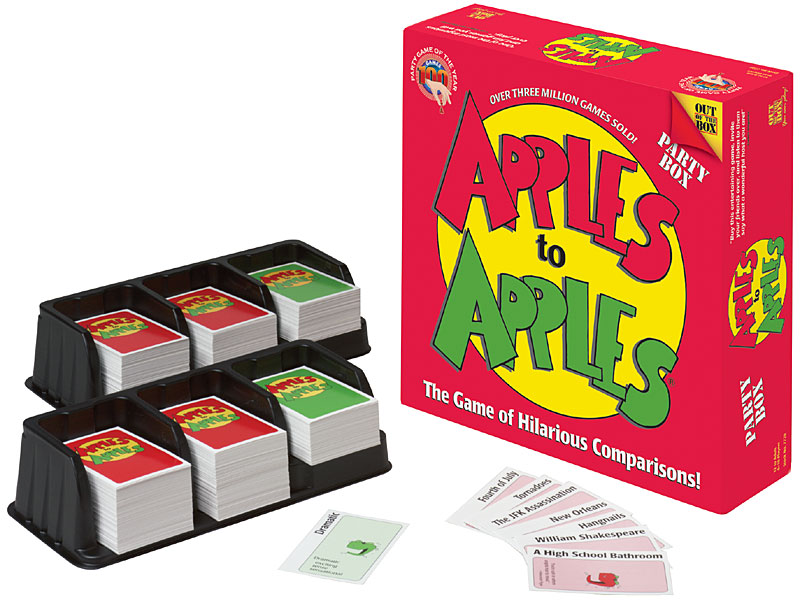
We also were particularly interested in ways that we might apply some of the mechanics from discussion games like Apples to Apples. Also, tor the classically-uninitiaed, there is also a serious (and seriously, nay wildly, popular) college-bowl-esque trivia contest in the classics sphere known as certamen. We also wanted to incorporate the high level of knowledge that participants in certamen have about all aspects of ancient history and culture in the new iteration of the CARDs.


Unfortunately we kept hitting the same brick wall over and over again: if you remove the straight numbers battles of something like Magic: the Gathering or Top Trumps, how do you determine a winner? Finally, at Games+Learning+Society 7.0 in June we saw the solution laid out before us: one of the mechanics of Eric Zimmerman’s (along with Local No. 12) renowned-in-the-game-community Metagame.

Metagame revolves around intelligent discussions about video games. From my perspective, the key mechanic in the Metagame ruleset is that any appointed bystander can function as a judge who decides the winner of the debate. This mechanic, I think, has a lot of implications for education.

On the CARD redesign

Decompressing after GLS, I sat down and laid out what would be the rules for what we now call CARD-tamen™ and the tie-in to the collection mechanic of Operation LAPIS. Also realizing that the original CARDs (while cool-looking) were obvious knock-offs of Magic: the Gathering, we also decided on a complete redesign centered around a Roman-themed deck with four categories of CARDs: historical people, significant ancient structures, places of renown, and Roman divinities.

We wanted to keep the overall feel of the CARDs the same but we needed a stylistic change that would allow us to be free of any litigation with Wizards of the Coast. The new designs, both in terms of content and style, are a beautiful representation of Roman culture in the form of a deck of cards.


Original Pompeiī CARD (left) and the new CARD (right)
On the rules of CARD-tamen™

The idea of CARD-tamen™ is simple: a roll of a d20 decides which of the twenty controversies the players will have to debate and then each participant, after selecting a CARD from their deck, has two minutes to prove to the iudex that their CARD is the more compelling answer to the controversy. The controversies range from declarations such as “More significant to world history” to “Greater contribution to the development of public speaking” to even “Inspired more significant stories.” (Students of Roman culture may recall that not-dissimilar controversiae formed an essential part of the education of young men destined for public life.)


In order to make their declamations better, players will go to resources beginning with Wikipedia and ending with scholarly articles on JSTOR to research more about their CARDs before playing their next game. In the very first round of play-testing with students, it took only minutes for one of them to take out a phone and look up some quick facts on Cicero. It took only a nano-second more for one of the other students to claim “Hey, that’s cheating!” to which the first student replied, “How? I’m using a resource to make my speech better.” When I heard about that exchange, I couldn’t have been happier: that’s precisely the effect that we wanted the CARDs to have. We’ve put just enough information on them to create a need to find out more.

But it’s the presence of what we call the iudex-mechanic, with its powerful effect of drawing in the bystanders to the activity, that makes the game matter, finally. Much research in educational psychology supports the notion that one of the most effective methods of helping students learn is fostering peer interaction. We hope that the iudex’s active role in deciding the winner will cause him or her, too, to feel the need to become more knowledgeable in the content covered by the 63 cards. In addition, anyone else observing the game will of course also hear the declamations made by each participant and gain knowledge of the topics.

The rules of CARD-tamen™ require the participant to talk intelligently about various aspects of Roman history and culture. That play objective also happens to be one of the learning objectives for an introductory Latin course or even a much more general course about civilization or history. The rules of the game foster the learning, rather than trying to transmit the content like so much chocolate on the broccoli of Roman culture.

----------

We just launched a Kickstarter campaign for CARD-tamen™ and would love the support from anyone interested in quality educational games or Classical studies. A preview of the 63 card deck (offered as one of the rewards for contributions) is located on the Kickstarter page:

9.12.2010

The First Days of Operation LAPIS, part 3

Continued from Part 2


As I noted at the end of the last entry, we had a rather large gap between meetings after the first two classes.  A total of six days had passed by before I saw them again.  My biggest fear was that all of the momentum we had from the first week would be lost after such a long layoff.  I worried that they would have forgotten all about the mechanics we talked about in week one and I would have to spend much of the coming week reintroducing everything rather than moving forward.  Another rather large concern of mine was taking a step back with regards to the atmosphere in the classroom.  Anyone who has ever taught a level one language or a group of predominately freshman, especially in a school as large as ours, knows that getting the students to participate and readily volunteer in the first few weeks is always a very difficult task.  They often don’t know very many other students in the class and they are extremely shy and reserved lest they make a mistake in front of twenty new faces.  Would we suffer a setback there as well?

One of the really great things about the way my schedule is set up for this year is where my two Latin I sections fall during the school day.  Our schedule changes every day, but these classes are always back-to-back and so I have an immediate comparison between the LAPIS section and the non-LAPIS section.  When we came back on that Wednesay after a six day layoff, it was a full six days for both sections.  They both sat through the whole period, mostly non-responsive despite my best attempts at the whole dog and pony show.  The LAPIS students did need time looking back at things we discussed in the previous week.  They needed a refresher on things like the TSTT Forums, the HUD, etc.  Many of them had not checked their email and so they did not know who was on their team nor did they visit the forums at all.  I had mostly expected this and, while disappointed, nevertheless we went through all of those topics again and by the end of the class they started to come back around a bit.  Their task for Wednesday evening was the log in and post in their newly assigned Team Forum and just say “hi” to their new teammates.  The main goal was the ensure that they all could post in the forums and reinforce how to navigate around.


I made myself available via Google Chat and email for most of the evening and quite a few of the students took advantage of that in order to figure out how to do everything.  They received a new CARD for doing so; Mons Vesuvius (and of course the LPs that go with it).  In the end, 21* out of 22 accomplished the task and started engaging in conversation with their teammates.  I was unprepared, I think, for the effect that this would have on the classroom dynamic the next day.


I saw the non-LAPIS class first and it was a fairly standard experience: they file in and sit in silence before the class starts, it is still a struggle to get them to open up to myself, to their classmates, to volunteer, to answer questions or contribute.  Nothing new or nothing surprising there.  Usually by the third week they start to come around and by the end of September we’re really in full stride with the atmosphere that carries through the rest of the year.  The LAPIS class, on the other hand, which came in directly after the non-LAPIS was an entirely different story.  They came in chatting to one another and immediately started talking with their teammates.  The dynamics for the rest of the class stayed at that elevated level.  While doing activities, a far greater number of hands shot up to volunteer, they more readily engaged in discussion back and forth about topics.  They responded to comments made by fellow classmates.  They more actively engaged with me.  To say there was a stark difference between the two classes after just one day would be a gross understatement.  There is absolutely no question in my mind that this came as a direct result of the relationships that they began to forge online the night before in the Team Forums.  You want a sure fire way to increase student engagement in the classroom?  Find a way to increase student engagement with each other outside of the classroom.

With the energy and enthusiasm firing on all cylinders, the Operatives were ready to head off Thursday night to do their first TSTT immersion prompt: Episode 1.1.a, The Boy in the Tree.  I had no idea when I left school on Thursday that what would unfold Thursday evening would exceed even my wildest expectations.  I’ll discuss what happened in my next entry.

*The 22nd student was the same student from the previous entry that was unable to accomplish the task.  He voluntarily approached me before class and asked if he could stay after school with me on Thursday to go through how to access the forums and go over, one on one, how to post, reply, etc.

9.06.2010

The First Days of Operation LAPIS, Part 2

Continued from Part 1

With almost the entire class having succeeded in their task to to create a Google Account and move on to the next steps, I congratulated them and promoted all of them from ‘Recruit’ status to ‘Operative’.  A few of the students who were not confident in their computer abilities questioned whether or not they had done everything correctly.  This sort of thing is to be expected.  I assured that all of them had indeed done all the steps just as I had wanted.  After some general discussion and feedback about the visual guide, we moved forward to talk about other aspects of the course.

There was still a rather large feeling of anxiety and apprehension in the air but I knew that this was going to be an important first week to quell those fears.  My goal for day two was to introduce some new components while still moving at a slow pace in order to prevent any kind of panic.  One of the students asked about the ‘Demiurge’ and so I explained to them that I, too, would be playing a role in the story as the Demiurge (think: The Architect in the Matrix).  I think it helped them to know that I would be role-playing along side of them and that most communication outside of class from me would actually be coming from the Demiurge.  After fielding another question of just what ‘Demiurge’ meant, I displayed the second email that they had received the night before and went through the links and instructions that were contained in it.

First I opened up an example Operative Dossier (LP “grade” sheet) and walked them through the layout and what all of the information was included on it.  For many of the students, they thought it was very beneficial to do this.  They all had opened up the document the previous night but weren’t sure what everything was.  We did the same with the Carta Collectionis (Collection Sheet) and they had the reaction that I had hoped they would have: they were excited about the CARDs.  It was abundantly clear to me at that moment that we had hit the nail squarely on the head and tapped into the ‘Pokemon-thing’.  They were very excited to hear that there were many more CARDs to collect, and each one had a different set of circumstances to earn them.  They also immediately picked up on the other benefit of CARDs: LPs.  The CARDs can help them advance in levels and thus advance in grade.  “Gotta catch ‘em all?”  I have a hunch that more than a few will try to collect ‘em all.

The first CARD that they received (which was a foil edition of Pompeii) came to play an immediate role in the next step of the process.  I brought up the TSTT (the discussion forums) on the screen and we walked through the different sub-forums listed and how each one functioned differently.  Again, this visual walkthrough (even though they had a print guide in their email) was a big step in making it more accessible and not so scary to the students.  We even took a look at the first immersion prompt, Episode 1.1.a, and talked about the role those will play each night.  They immediately picked up on the TSTT Navigation Device (a custom Google Map link), so we took a look at that as well.  The first point in their narrative takes them just outside of the city of Pompeii, on a road, by a tree.  The shadow of Vesuvius looms overhead.  For many (if not all), they weren’t sure where we were geographically and so I showed them how to use the TSTT Navigation Device to their advantage.  Zooming out just once gave us a clear image of where Vesuvius was in relation to our characters.  Ah hah! That volcano!  Now we are getting somewhere.  Some did know that Pompeii was one of the towns devastated by the eruption so my next question to them, “When did this happen?”.  The first response blurted out was “That was on the CARD!”  Success!  The Operatives now know that they can gain relevant and important information from their CARD collection.

Their task for the second night was to log into the TSTT and create their own personal achievement thread in the appropriate forum.  This area is where the Demiurge is going to offer public congratulations and dole out titles and honors.  Two more students picked up special titles and some real honest learning took place.  Not satisfied with my assurance that they could think of the Demiurge as an all-powerful-creator-figure, one of the students looked up the Greek origins of the word and posted it for all the other Operatives to see.  He confirmed my definition, used the internet as a valuable research tool, and shared his discovery with the class.  For his efforts, he was awarded ‘Venātor Verbōrum’ or ‘The Hunter of Words’ as his title.

Day two was an overwhelming success.  It was apparent that a few who were very uneasy after the first day of class started to come around and be more receptive to the whole idea of what we were going to be doing.  It is too bad that I lost day three to “Hurricane” Earl.  I’ll meet with the Operatives again on Wednesday, so stay tuned for a discussion on the third (and final) day of the introduction to LAPIS where they will receive their Recentiī Teams and start learning their first bit of Latin.

9.04.2010

The First Days of Operation LAPIS, Part 1

Operation LAPIS has launched at the Norwich Free Academy with great fanfare; at least in my mind, anyway.  I want to spend a little bit of time to put down my thoughts from the first few days about what transpired, what worked and what could be improved for version 2.0 next year.

The first day of school is a shortened day in which every class only meets for thirty minutes.  Thirty minutes is not a lot of time to explain to a room of mostly freshman, in their first day at an enormous school, that what they will be doing in Latin this year is going to be completely different from anything they have done previously in any academic setting.  At our stage of development (both of LAPIS and of practomime in general) one of the biggest challenges we face is still explaining, in a concise manner, just what exactly we are doing.  The question of how to go about this task preoccupied my mind the weekend and first part of the week leading up to Wednesday.

What I ultimately decided was to move at (what I would consider) a very slow pace as I introduced the various components over the first three days.  After letting them know that they would be doing something that hasn’t ever been done in a high school course before, I (at the very least) had their attention for the remainder of the short class.  We spent some time talking about the idea of ‘practomime’ and I tried to help them wrap their minds around the ‘role-playing’ aspect of the course.  My goal was to try to explain everything in a way that didn’t use other comparisons as a crutch (i.e., the Matrix thing).  In the end, using examples from popular culture proved to be more useful that I had originally thought it would be, and after making the loose connection of TSTT = the Matrix, conceptually we could move forward.

Throughout the entire class, part of me was a little terrified internally because of the looks on the student’s faces.  I could see it in their eyes that they were all thinking to themselves, “Holy cow, this guy is completely insane.”  Which, in all honesty, is to be expected given the drastic departure from “business as usual” that we are hoping to achieve with LAPIS.  Their homework for the first evening was simple: use the visual guide that I handed to them to create a new Google Account and to make first contact with the Demiurge (me) by sending a simple email that read “Awaiting further instructions.”

I had no idea what to expect.  I had no idea if half the class was going to run in a panic to try and get switched out of the course.  I couldn’t get a good reading from them at the end of the first thirty minutes.  I later found out that day that one of the students was in such a pensive state about the whole concept of LAPIS that they went to the wrong class the following period and sat through the whole thing before realized that they were in the wrong place.  While I feel bad about that, it reaffirmed that I had done something right in the presentation of the first steps.  If anything, it was a compelling enough start to have them momentarily lose themselves in the idea of Operation LAPIS.

After the day finished and the students boarded their buses, I enjoyed a fun lunch upstairs in the lounge with some of my colleagues, laughing and joking about the first day back.  Little did I know that while I had been eating my turkey sandwich, a half-dozen LAPIS ‘Recruits’ had rushed home and done the steps necessary to start the process of becoming full blown ‘Operatives’.  By the time I had finished my hour long drive back home, another half-dozen had done the same.  At the end of the evening, 21* out of the 22 students in the class had followed the instructions perfectly and created their accounts.  The majority of them waited for the followup email and performed those challenges as well (registering with the forums, viewing their first CARD, etc).  The first student to finish all the challenges was awarded a special title, ‘Celerrima’ (‘the quickest’), which will display by their name every time they post.

Day 1, by my reckoning, was a complete success and set up perfectly a productive second day.  I’ll go into the details of that in a post later this weekend.  Stay tuned for more.


*I talked to the 22nd student before class started on the second day.  He gave the standard student excuse for not doing a computer-based assignment that I’ve become accustomed to hearing: “Oh, my computer is like broken or something.”  I explained to him everything we are doing outside of class required that he have access to a computer and that if he couldn’t get his computer fixed, we’d have to see about moving him to a different section of Latin I.  By 2:30pm that day (school ends at 2:15), he had taken the steps required to move ahead.

8.18.2010

Latinity Points

On Monday, I discussed the CARD mechanic and the cartae collectionis. Today I would like to explain our mechanic called 'Latinity Points'.

Latinity Points (LPs for short) are the mechanism through which grading occurs during Operation LAPIS. As you may know, in role playing games (RPG’s) like Dungeons & Dragons and World of Warcraft, players advance towards game objectives by collecting 'experience points' (XP). Once a character has gained enough XP (at predetermined milestones), that character is able to advance a 'level' and usually gains new skills and abilities. We wanted to capture the same essence with LAPIS and so that naturally lead us to LPs.

Operatives (that is, the students) receive LPs for everything they do in the operation (that is, the course). Some of the things they do happen inside the role-playing (practomime) activity-- the time-machine/simulation called the TSTT; other things happen in a more traditional-looking way in the classroom. A carefully constructed practomime response will earn more LPs than one rushed, incomplete, or lacking in any research or Latin. Likewise, standard looking assessments (called attunement exercises) also award LPs in a scale that looks very familiar to students, parents and administrators alike. For example, if on a vocabulary quiz, the operative received what would be a 90% ordinarily, he or she would receive 90 LPs. It is a system that scales incredibly well depending on the gravity of the task.

All of the activities in any given mission (there are 14 in course) add up to a total of 3000 LP. As in real RPGs, these numbers are artificially inflated for no reason other than that people like to receive really big numbers for doing tasks. It is a mechanic that has been a staple of RPGs for nearly three decades. In LAPIS we hope that it'll have the same effect. Receiving 47 LP for a great practomime response is a whole lot more gratifying than receiving 5 LP or even a 9 out of 10 on the top of a page.

So what do these LPs mean for the student? A couple of things, actually. For starters, we do have a level scale built into the practomime. In this version of Operation LAPIS, levels don’t have an effect inside the role-playing portion of the course, but every operative will have a private dossier that prominently displays his or her level. For reasons of privacy, we can’t display that information to the rest of the class, but we suspect that students will want to do so themselves, creating healthy rivalry inside the operation team as a whole. In future iterations, we expect that we'll be able to devise other uses for these levels including different skills, options available during practomimetic prompts, etc. Even with the current simple system, though, there is something to be said for the gratification that accompanies 'gaining a level', even if it is just cosmetic. The current scale is listed below:

1. 0
2. 100
3. 350
4. 850
5. 1,700
6. 3,000
7. 4,850
8. 7,718
9. 10,730
10. 14,435
11. 19,738 (25,500 - maximum total at the end of the 1st sem. for 100% LP awards)
12. 24,143
13. 30,755
14. 37,690
15. 45,523

As the scale above indicates, the maximum total for each semester is 25,500 LPs. Most students should be able to hit level 11 by the end of the first semester. Level 14 will equate to a grade of B and level 15 to a grade of A. We may still play around with the LP distribution a bit, but at this point I am pretty happy with how the levels span out over the course of the year.

Likewise, here's the other half of the LP system: actual grades. We use a traditional grade scale, multiplied many times over. This system counts the LP gained from the CARD collection mechanic as 'alternative ways to advance', something that might be called ‘bonus points’ in a traditional course. With the amount of work (and learning) that will go into earning those points, it makes much more sense to factor them in more substantially.

Grades (per semester) are determined as follows:

>21,855 - A
21,854...21,056 - A-
21, 055...20,351 - B+
20,350...19,411 - B
19,410...18,706 - B-
18,705...18,001 - C+
18,000...17,061 - C
17,060...16,356 - C-
16,355...15,561 - D+
15,560...14,711 - D
14,710...14,100 - D-
<14,099 - F

All in all, the Latinity Point system should prove to be another in a series of mechanics that serve to further motivate and engage the students beyond the traditional way grades are handled. Each student will have an online private dossier viewable in Google Docs (which can only be edited by the Demiurge and only viewed by the student signed in to their Google account) which tracks their LP awards for all missions, broken down by episodes and activities, and provides them with their current total LP and level so that they know exactly what their current status is in the class.

Again, thoughts, feedback and ideas are always appreciated!